EXAMPLE
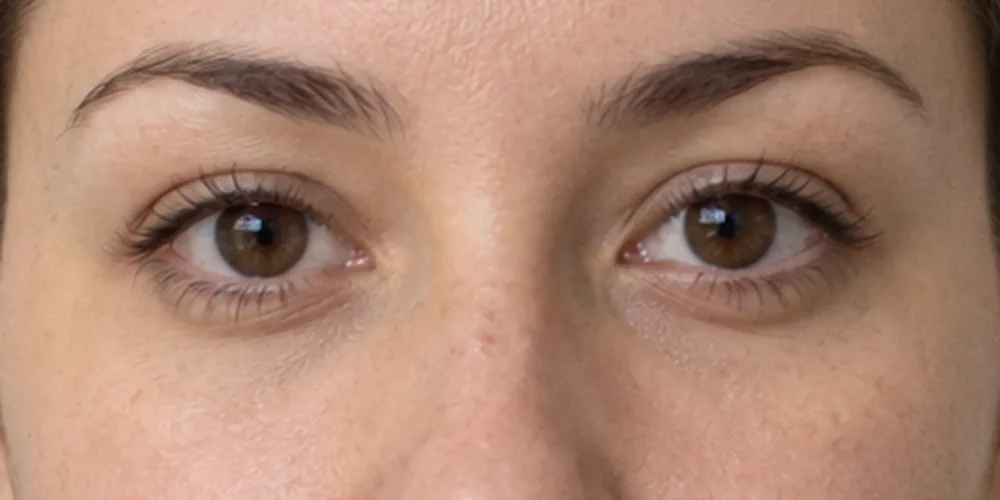
- Canthal tiltouter corners sit above the inner
- +6.0°
facetiers.comphoto never uploaded
Canthal tilt is the angle of the line from the inner to the outer corner of the eye, positive when the outer corner sits above the inner one. This tool measures it from 478 points on your photo, in your browser, and shows it to the nearest 0.5°.
Your photo stays here.
16.7 MB unpacked, about 5.8 MB sent compressed. First time only. It stays in your browser's cache for your next visit.
No upload at any step. Close this tab and your photo is gone.
The face model could not be loaded. Check your connection and try again.
Straight on, in good light, one face.
Light, camera height and expression can move this score by about a point from one photo to the next.
facetiers.comphoto never uploaded
Press and hold the card to save or share it. The image is drawn on this phone; nothing leaves it unless you post it.Hover the card to save or share it. The image is drawn on this device; nothing leaves it unless you post it.
One-time PDF · US$9.90
US$9.90, paid once. Not a subscription: nothing renews.
Choose a photo of one face looking straight at the camera, within 5° of straight. Another photo of the same face can give a slightly different angle.
A generated face, not a real person: dashed lines are level, solid lines run from the inner to the outer corner of each eye. The tag shows +6.0°, read as the mean of both eyes.
| Sign | Tilt shown | What the line does |
|---|---|---|
| Positive | +0.5° or more | The outer corner sits above the inner corner |
| Level | Between −0.5° and +0.5° | The two corners are about level |
| Negative | −0.5° or less | The outer corner sits below the inner corner |
Canthal tilt is the angle of the line that joins the inner corner of the eye (medial canthus) to the outer corner (lateral canthus), measured against a level line. When the outer corner is higher, the tilt is positive; when it is lower, it is negative.
Positive means the outer corner sits higher than the inner corner. A paper in a Korean journal describes a negative tilt as the lateral canthus lying lower than the medial canthus (Synapse), and a 2019 paper on dynamic canthopexy notes the lateral canthus normally sits about 2 to 3 millimetres above the medial one (PDF). Sign conventions are not the same everywhere, so check which one a source uses.
We found no general normal range that can be sourced, so this page gives none. What exists are sample averages. A study of young Korean adults reports a mean of 8.45° (right) and 8.42° (left), with a spread of about 3.5° to 3.8° (Synapse), and a Korean reference cited elsewhere gives 7.9° for men and 8.8° for women (PMC). These are averages of one population, measured by clinical methods, so they do not set a limit and are not directly comparable to a tilt read from a photo.
Choose a photo of your face looking straight at the camera and this page does it for you: it finds the inner and outer corner of each eye, takes the angle of each line with the face levelled on the cheekbones, and shows the mean of both eyes to the nearest 0.5°. The angle is positive when the outer corner sits above the inner one. A head tilted or turned in the photo, a different lens or a smile can change the result a little.
A little. When we read the same image after shrinking, darkening, brightening, blurring or compressing it, the tilt moved by about 0.4° (standard deviation). Across different studio portraits of the same person, after the face was turned to front-on, it moved by about 0.6°. Selfies vary more, because light, lens and expression vary more.
The medical literature describes surgical techniques that change the position of the outer corner of the eye, such as lateral canthoplasty (2016) and dynamic canthopexy (2019). Those papers are about clinical cases and are not a recommendation, and this page gives no advice on it. If you are thinking about it, talk to a doctor.